|
USSA
News
South Africa and Canada crowned FISU champions in Stellenbosch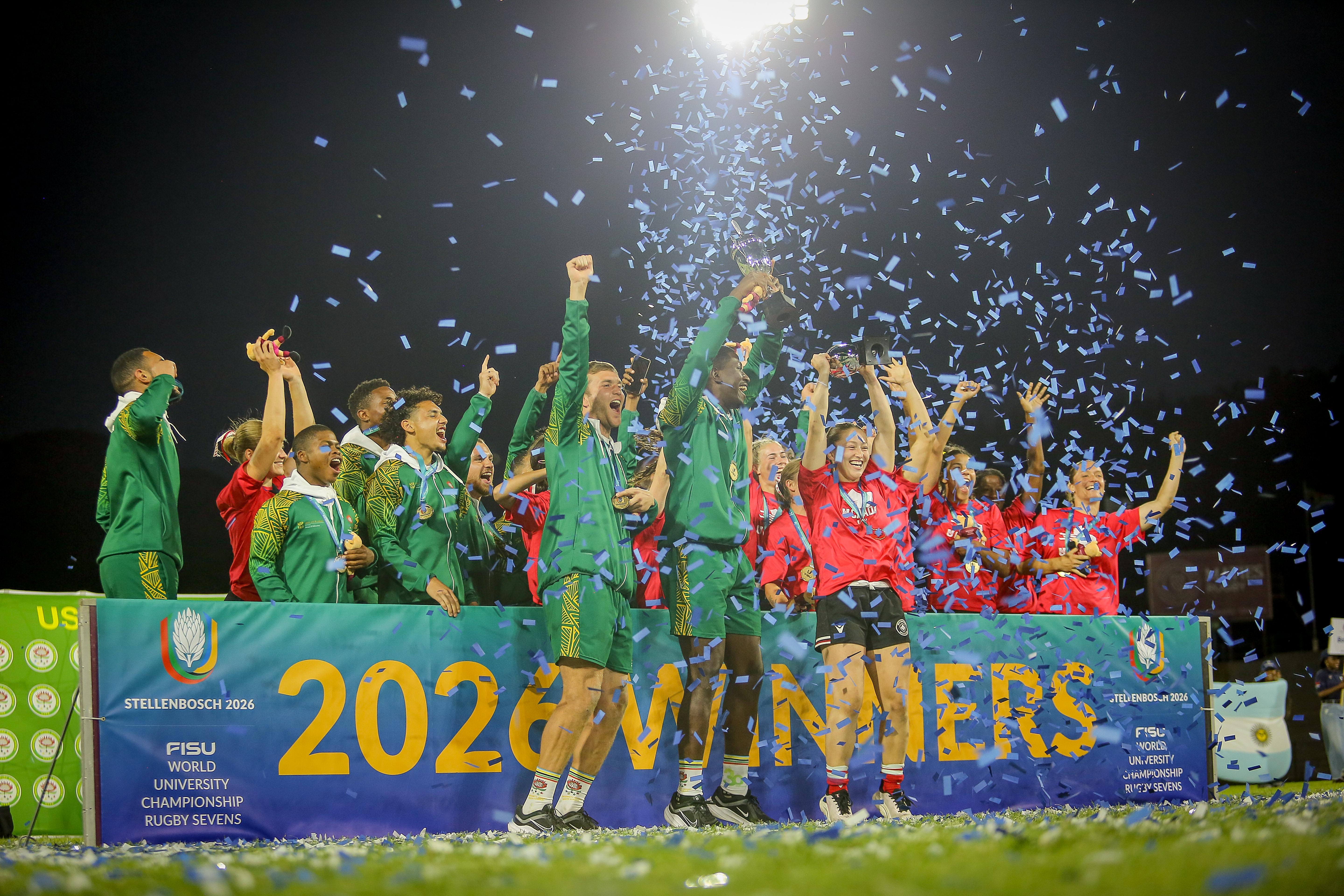
South Africa and Canada were crowned champions of the 2026
FISU World University Championship Rugby Sevens after producing dominant
performances in the men’s and women’s finals at the Danie Craven Stadium in
Stellenbosch on Sunday, 6 September. The hosts completed an unbeaten campaign
with a commanding 34−7 victory over Uganda, while Canada kept France scoreless
in a 20−0 victory to claim their fourth women’s FISU title.
The final day provided a fitting conclusion to three days
of competitive university rugby, with dramatic semi−finals, closely contested
medal matches and several standout individual performances. South Africa’s men
and Canada’s women ultimately proved the strongest sides in their respective
competitions, while Uganda’s historic run to the men’s final and Japan’s podium
finish in the women’s competition were among the other highlights of the
championship.
South Africa dominate men’s final
South Africa produced a commanding first−half performance
to beat Uganda 34−7 in the men’s final and secure their first FISU World
University Championship title since 2018, when the tournament was hosted in
Swakopmund, Namibia.
The hosts raced into a 22−7 lead at the interval before
maintaining their control after the break. Their combination of pace,
physicality and spatial awareness proved too much for Uganda, with the home
crowd providing an additional lift as South Africa closed out an impressive
tournament on home soil.
Leachim Adams was central to the victory, scoring a
hat−trick, while Aaron Swartz added two tries and Raymond Gordon also crossed.
Swartz converted three of South Africa’s tries.
Uganda’s only try came through Stuart Mwayi, with Calvin
Gizamba adding the conversion, but the East Africans could not reproduce the
performance that had carried them into the final.
South Africa 34 (22)
Tries: Leachim Adams (3), Aaron Swartz (2), Raymond
Gordon
Cons: Swartz (3)
Uganda 7 (7)
Try: Stuart Mwayi
Con: Calvin Gizamba
Canada complete unbeaten women’s campaign Canada produced a clinical performance to beat France 20−0
in the women’s final and secure their fourth FISU World University Championship
title.
The Canadians led 15−0 at half−time before completing the
victory after the break, with Ava van Santen scoring all four tries. Canada’s
defensive discipline was equally impressive as they kept France scoreless
throughout the final.
The victory added the 2026 title to Canada’s previous
championship successes in 2004, 2006 and 2014. It also marked their seventh
appearance in a FISU women’s final.
France settled for silver after a strong tournament that
saw them overcome defending champions Japan 23−12 in their semi−final. Their
physicality at the breakdown was a feature of their campaign, but they were
unable to break through Canada’s defence in the final.
Canada 20 (15)
Tries: Ava van Santen (4)
France 0 (0)
Leachim Adams named Men’s Player of the Tournament and Top Try Scorer
Adams was named the Men’s Player of the Tournament after an
outstanding campaign for the hosts. The South African finished as the
tournament’s leading try−scorer with nine tries and top point−scorer on 45
points. His pace, attacking awareness and ability to exploit space made him one
of the most influential players across the three days.
His hat−trick in the final provided a fitting conclusion to
his tournament and helped South Africa secure the title in front of their home
supporters. Adams also won the top try scorer of the men’s division.
Ava van Santen named Women’s Player of the Tournament and Top Try Scorer
Van Santen was named the Women’s Player of the Tournament
after playing a central role in Canada’s successful title campaign.
Her four tries in the final took her tournament tally to
12, making her the leading try−scorer of the championship. She edged Australia’s
Leilani Hills, who finished with 11 tries, after Hills had been among the most
prolific attacking players throughout the tournament.
Van Santen’s combination of attacking skill, pace and
composure proved decisive for Canada, particularly in the final as the Canadians
completed an unbeaten championship campaign.
Fair Play Award − Japan Men
Japan’s men’s team received a Fair Play Award in
recognition of their professionalism and sportsmanship throughout the
championship.
The defending champions conducted themselves with respect
both on and off the field, demonstrating discipline, respect for opponents and
officials, and a strong commitment to the spirit of the game.
Their approach reflected the values promoted by World Rugby
and FISU, with the team contributing to the positive sporting environment
throughout the tournament.
Fair Play Award − Japan Women Japan’s women’s team were also recognised with a Fair Play
Award for their conduct throughout the championship.
Despite relinquishing their title, the Japanese team
continued to display professionalism, respect and good sportsmanship throughout
their campaign. Their conduct on the field reflected the principles of fair
competition and mutual respect that underpin university sport.
The award was a fitting recognition of a team that upheld
the values of World Rugby and FISU while competing at the highest level of the
championship.
Final day provides plenty of drama
The men’s competition had already produced a dramatic start
to the final day, with Australia beating Mexico 43−0 in the opening match. Aidan
Wearne was one of the standout performers as Australia’s pace and attacking
movement proved too strong for Mexico.
South Africa then produced one of their strongest
performances of the tournament to beat defending champions Japan 38−5 in the
first men’s semi−final. Aaron Swartz and Keno Alexander were among the key
performers, while Adams, Lukhangele Tshayi and Van Reenen Kruger also
contributed as the hosts established a 19−0 half−time lead.
Uganda followed with one of the day’s most dramatic
results, beating Argentina 17−14 in the second semi−final. Allan Karuhanga
scored twice, including the injury−time match−winning try after the siren, while
Darren Aine also impressed as Uganda secured their place in the historic
all−African final.
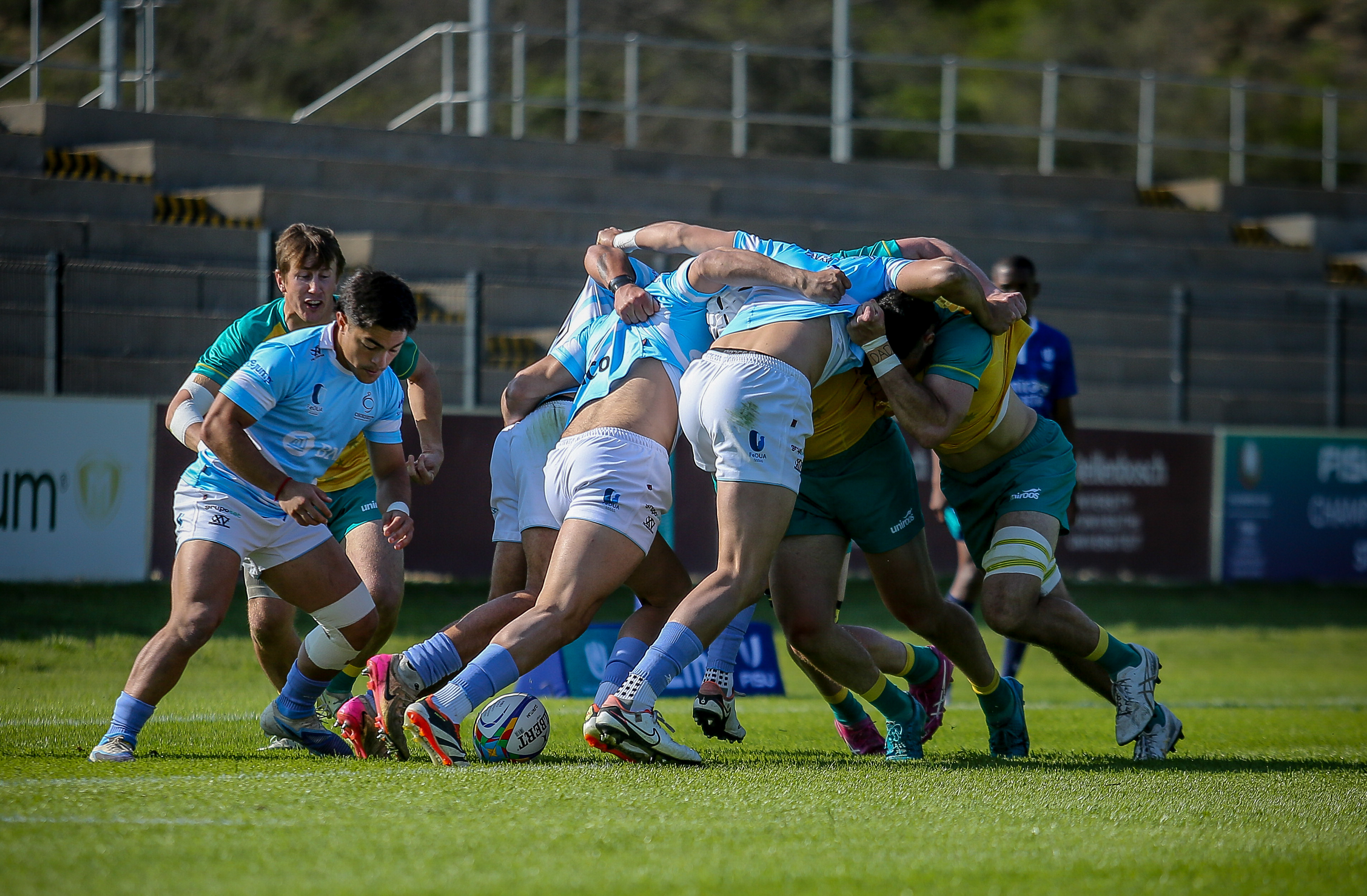
Argentina recovered to take the men’s bronze medal, edging
Japan 28−26. Nahuel Clausen again proved influential for Argentina, while Japan
remained competitive through Tatsushi Yabu and Kohki Yoshida.
Australia secured fifth place with a 21−12 victory over
Chile, with Mitchell Moss, Milo Plastow and Zander Esterhuizen among the
standout performers. Chile finished sixth, while Zimbabwe claimed seventh after
a dramatic 28−24 victory over Mexico, sealed by PK Manyakara’s try after the
final hooter.
In the women’s competition, Japan recovered from their
semi−final defeat to France by beating Australia 22−5 to claim bronze. Kaoru
Fujiwara, Hinano Sugimoto, Ichika Kuki and Nodoka Miyamoto were among Japan’s
key contributors.
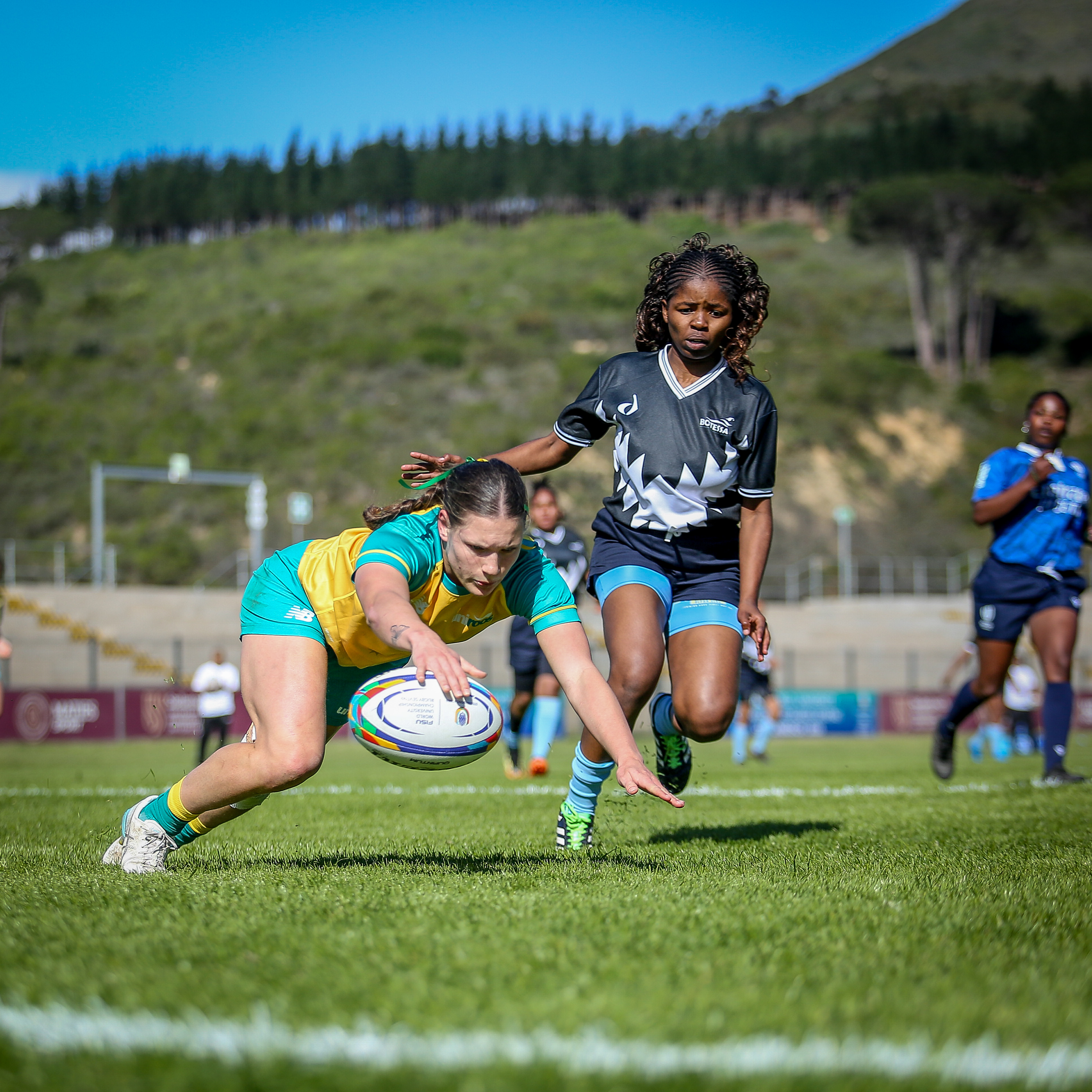
Australia finished fourth after their narrow 19−14
semi−final defeat to Canada. Leilani Hills and Maronay Smuts continued their
impressive attacking campaigns, finishing with 11 and seven tries respectively.
The battle for the remaining places began with the USA
beating hosts South Africa 24−12 in the opening 5–8th place play−off. Emma
Buxton, Cameron Fields and Vivianne Wright were among the USA’s standout
performers as they progressed to the fifth−place play−off.
Ireland then secured fifth place with a 26−17 victory over
the USA, with Rola Olusola, Chisom Ugwueru and Faith Oviawe making important
contributions. The USA finished sixth, while South Africa ended their home
tournament in seventh place.
Siyonela Macamba provided one of the highlights of the
South African women’s campaign with an outstanding individual try against Japan
on the opening day, while Elme Kruger was another important contributor
throughout the tournament.
Botswana finished eighth after withdrawing from the
final day matches due to player welfare considerations.
Final men’s standings (1−9)
South Africa
Uganda
Argentina
Japan
Australia
Chile
Zimbabwe
Mexico
Norway
Final women’s standings (1−8)
Canada
France
Japan
Australia
Ireland
USA
South Africa
Botswana
|
 |
 |
|
|
Posted by Maties Sport on 09 September 2026
Source:
|
|


